4-Class Pack
$380$95
per class
Book a Free Trial
per class
- 4 × 2-hour classes
- About a month of weekly classes
Our PSLE Math lessons build conceptual understanding alongside exam technique. Students learn why each method works and how to select an appropriate heuristic, so they can approach word problems and unfamiliar questions independently.
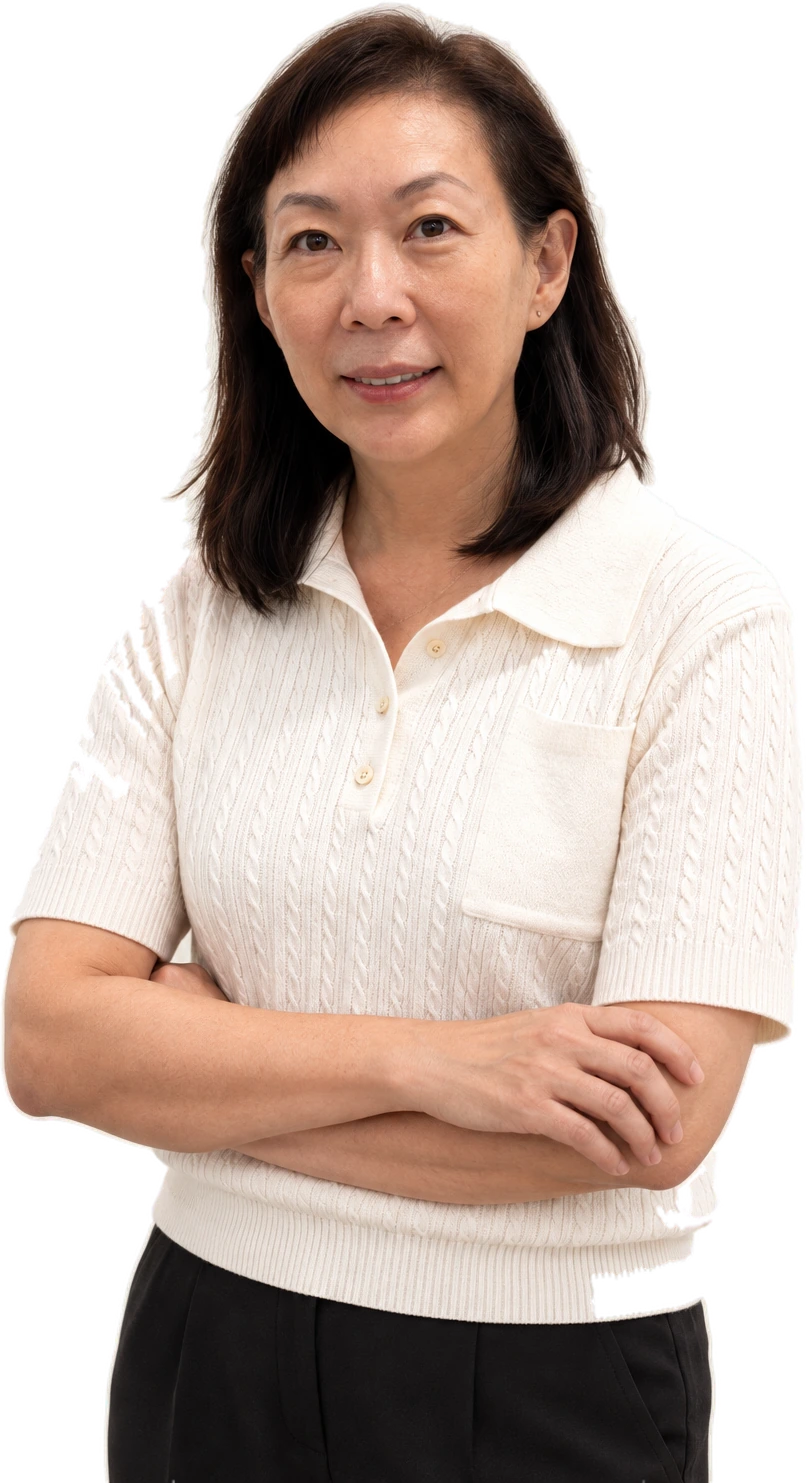
With more than 20 years of teaching experience, Mdm Susan has guided many batches of students through the PSLE.

Ms Eve holds a Mathematics degree from NTU and a Master’s degree in Mathematics from NUS.
You might notice: Your child gets the sum right but isn’t sure what the answer should be.
Key Topics This Year
Worked Example
There are 30 children going on a school trip. Each van can take 8 children. What is the least number of vans needed to take all the children?
Many children work out 30 ÷ 8 = 3 R 6 and answer 3 vans. But the 6 children left over still need a van, so the answer is 4 vans.
30 ÷ 8 = 3 R 6
3 vans + 1 more van = 4 vans
How we help: We teach your child to ask what the remainder means before writing the answer: sometimes it can be ignored, sometimes it needs one more group. Here, “R 6” is 6 children without a seat, so one more van is needed.
You might notice: The same mistakes keep coming back, or your child says, “I don’t like fractions.”
Key Topics This Year
Worked Example
In a class, 34 of the pupils wear glasses. There are 12 more pupils who wear glasses than pupils who do not. How many pupils are in the class?
Many children treat 12 as the number of pupils who wear glasses and get 16. But 12 is the difference between the two groups, which is 2 units.
With glasses: 3 units; without: 1 unit
3 units − 1 unit = 2 units = 12, so 1 unit = 6
Class: 4 units = 4 × 6 = 24 pupils (not 16)
How we help: We use model drawing to show what a fraction means before your child calculates with it. Here, your child draws the class as 4 units, 3 with glasses and 1 without, and sees that the 12 is the difference of 2 units.
You might notice: Your child shows plenty of working but still loses marks.
Key Topics This Year
Worked Example
Mrs Tan spent 25 of her money on a dress and 14 of the remainder on a bag. The dress cost $45 more than the bag. How much money did she have at first?
A common mistake is to take 14 of all her money for the bag, which gives $300. But the 14 is of the remainder, so the bag is only 3 of 20 units, and she had $180 at first.
Dress = 25 of 20 units = 8 units
Bag = 14 of the 12 units left = 3 units
8 units − 3 units = 5 units = $45, so 1 unit = $9
At first: 20 units = $180 (not $300)
How we help: We teach your child to plan longer questions with a model, labelling what is left after each step. Here, they draw her money as 20 units, so that both the 25 and the 14 of the remainder are whole units.
You might notice: Your child can do ratio and percentage on their own, but gets stuck when one question needs both.
Key Topics This Year
Worked Example
In a school club, 40% of the pupils were boys. After 30 girls left the club, the ratio of the number of boys to the number of girls became 4 : 5. How many pupils were in the club at first?
Many children simplify 40 : 60 to 2 : 3 and compare it with 4 : 5, but those units are different sizes. Writing 40% : 60% as 4 : 6 keeps the boys at 4 units in both ratios, because the number of boys did not change.
Boys : girls = 40% : 60% = 4 : 6
Boys stay at 4 units; girls go from 6 units to 5 units
1 unit = 30 girls, so at first: 10 units = 300 pupils
How we help: We teach before-and-after models for changing ratios, with the unchanged quantity drawn the same length in both. Here, the boys stay at 4 units, so the 30 girls who left are 1 unit.
Many students struggle not because the current topic is difficult, but because earlier concepts were never fully understood. We find those gaps and strengthen them alongside current learning, so the next topic is easier to learn.
Students learn how to identify common PSLE question types and choose the most suitable heuristic instead of applying the same approach to every problem.
Students learn to identify key information, organise their thinking and break complex word problems into smaller, manageable steps before solving.
We guide students to think through problems systematically, so they become less reliant on hints and are able to tackle unfamiliar PSLE Math questions on their own.
Come and try a PSLE Math lesson with us.
Your child can get to know our teachers in a complimentary 2-hour class. A short assessment helps us see where they need support, and we’ll talk you through what would help them most.
Please bring their latest school Math test paper.