4-Class Pack
$420$105
per class
Book a Free Trial
per class
- 4 × 2-hour classes
- About a month of weekly classes
Algebra is a core foundation of Secondary Math, and we place strong emphasis on helping students get it right. We teach why each method works and how topics connect, so students can apply their understanding to unfamiliar questions in E-Math and A-Math.

Ms Eve holds a Mathematics degree from NTU and a Master’s degree in Mathematics from NUS.
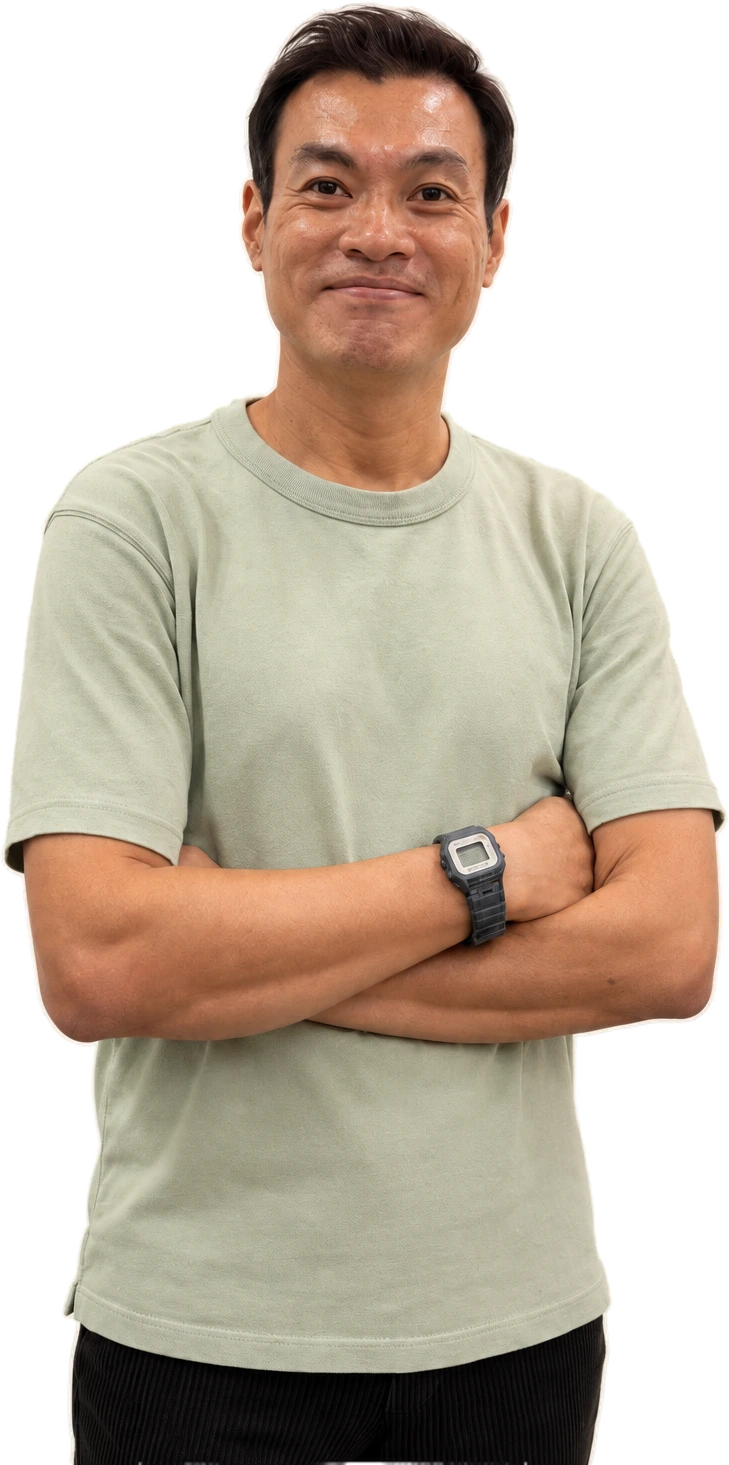
A former MOE school teacher, Mr Jay has more than 20 years of experience teaching Math in secondary schools.
You might notice: Your child’s marks drop after PSLE, or they say, “I don’t get algebra.”
Key Topics This Year
Worked Example
Given that x = −5, find the value of 3 − x.
A common mistake is to write 3 − 5 and get −2. Putting −5 in brackets gives 3 − (−5), which is 8.
3 − x = 3 − (−5)
= 3 + 5 = 8 (not −2)
How we help: We show your child why subtracting a negative number is the same as adding the positive one, instead of handing them a rule to memorise. Here, 3 − (−5) asks how far 3 is above −5 on a number line: 8 steps, so 3 − (−5) = 3 + 5 = 8.
You might notice: The same “careless” mistakes keep turning up in different topics.
Key Topics This Year
Worked Example
Simplify x² − 9x² + x − 6.
A common mistake is to cancel the x² terms. Only a common factor can be cancelled, so the numerator and denominator are factorised first.
x² − 9x² + x − 6 = (x + 3)(x − 3)(x + 3)(x − 2)
= x − 3x − 2
How we help: We teach your child to factorise fully before cancelling anything in an algebraic fraction. Here, they write the numerator and denominator as brackets, then cancel the common factor (x + 3).
You might notice: You’ve memorised the formulas but aren’t sure where to start on longer questions.
Key Topics This Year
E-Math
A-Math
E-Math
A chord AB subtends an angle of 1.2 radians at the centre O of a circle of radius 10 cm. Find the area of the minor segment.
A common slip is leaving the calculator in degrees, which gives 59.0 cm² instead of 13.4 cm².
Sector OAB = 12 × 10² × 1.2 = 60 cm²
Triangle OAB = 12 × 10² × sin 1.2 = 46.6 cm²
Segment = 60 − 46.6 = 13.4 cm² (not 59.0 cm²)
How we help: We teach you to break an unfamiliar area into shapes you already know, and to check your calculator mode before working in radians. Here, the segment is sector OAB minus triangle OAB.
A-Math
Find the range of values of k for which the curve y = x² + kx + 9 lies entirely above the x-axis.
Many students reach k² < 36 and write k < 6, but k = −7 is less than 6 and the curve then crosses the x-axis.
b² − 4ac < 0: k² − 36 < 0
(k + 6)(k − 6) < 0
−6 < k < 6 (not k < 6)
How we help: We teach you to solve quadratic inequalities with a sketch of the curve, rather than by taking square roots. Here, the sketch of k² − 36 is below the axis only between −6 and 6.
You might notice: You can follow the steps in class but get stuck on exam-style questions.
Key Topics This Year
E-Math
A-Math
E-Math
A bag contains 5 red balls and 3 blue balls. Two balls are taken at random without replacement. Find the probability that they are of different colours.
Many students work out red then blue, 1556, and miss blue then red.
P(red, blue) = 58 × 37 = 1556
P(blue, red) = 38 × 57 = 1556
P(different) = 1556 + 1556 = 1528 (not 1556)
How we help: We teach you to draw a tree diagram for any question with more than one draw. Here, the second branches are out of 7, and both paths with two different colours are added.
A-Math
A particle moves in a straight line so that its displacement, s m, from a fixed point O, t seconds after leaving O, is s = t³ − 6t² + 9t. Find the total distance travelled in the first 4 seconds.
Many students give s = 4 at t = 4 as the answer, but the particle turns back twice on the way.
v = 3t² − 12t + 9 = 3(t − 1)(t − 3), so v = 0 at t = 1 and t = 3
s = 4 at t = 1, s = 0 at t = 3, s = 4 at t = 4
Total distance = 4 + 4 + 4 = 12 m (not 4 m)
How we help: We teach you to find when v = 0 before working out any distance. Here, the particle stops at t = 1 and t = 3, so the journey is split into three stages and the distances are added.
IP Year 1 to 4 students join the Sec 1 to 4 class for their year.
Algebra is used in graphs, trigonometry, geometry and many other topics. Gaps in algebra can cost students marks even when they understand the topic itself. We continue strengthening their algebra beyond lower secondary, right through to the O-Levels.
Students learn where formulas come from, why they work and when to use them. This helps them apply formulas with understanding instead of simply recalling them.
Questions can combine concepts from several topics, such as differentiation to find a tangent and coordinate geometry to find the area it forms with the axes. We help students see how these concepts connect so they can tackle questions that draw on more than one topic.
Students learn to identify what a question is really testing and adapt what they know to solve unfamiliar O-Level E-Math and A-Math questions with confidence.
Come and try a Secondary Math lesson with us.
Students can get to know our teachers in a complimentary 2-hour class. A short assessment helps us see where they need support, and we’ll talk you through what would help them most.
Please bring the latest school Math test paper.